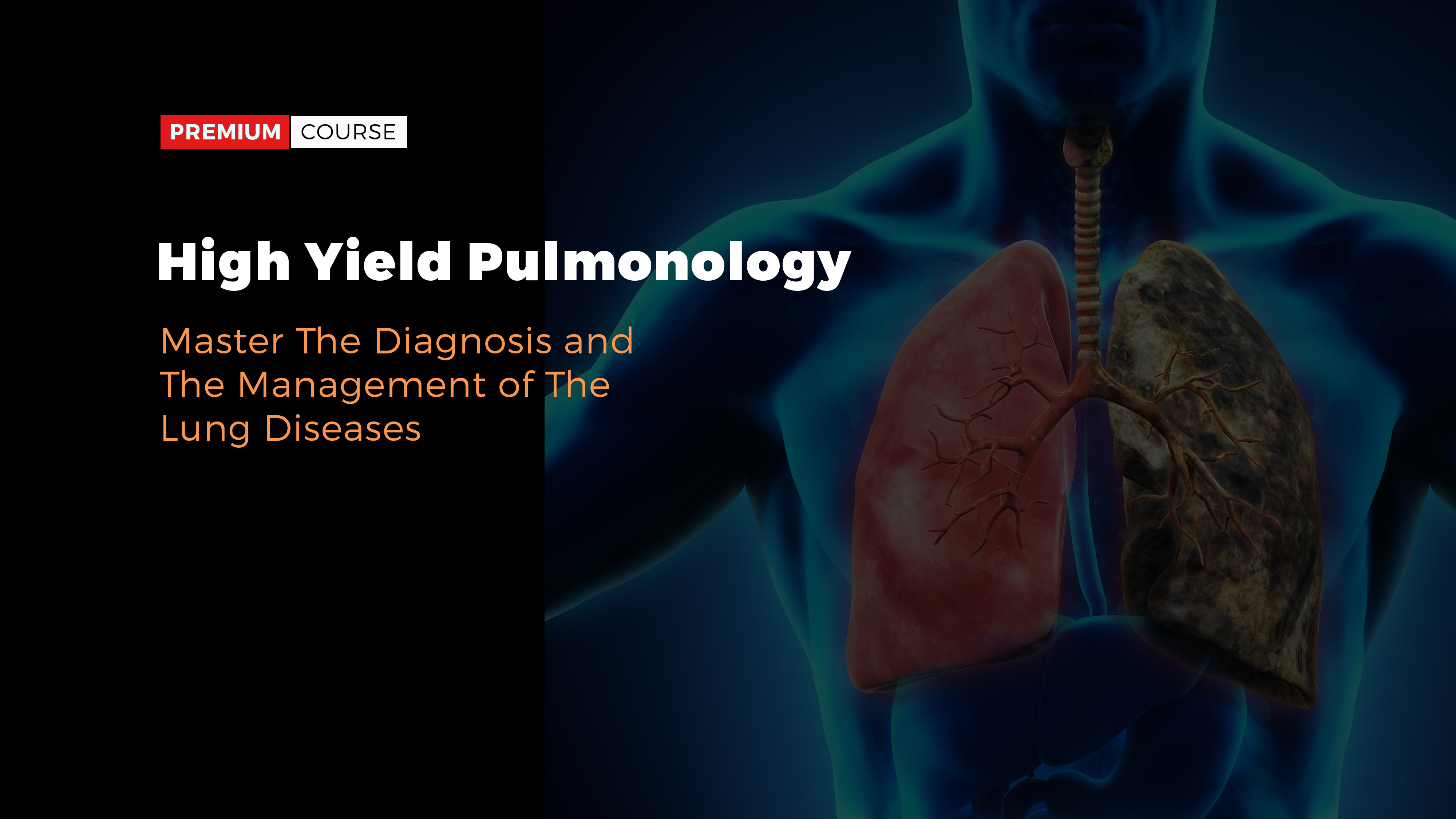
Respiratory System
Premium Course
Clinical
This module contains some of the most watched lectures at DrBeen.
We will start with an exhaustive but easy explanation of chest x-ray interpretation. You will learn how to approach a chest x-ray. Understand the film quality. Understand the normal vs. abnormal structures. Learn the mnemonic that will guide you for a systematic approach to the x-ray, the clinical basis of various x-ray abnormalities, and the most common chest x-ray abnormalities and their presentation.
Learn clinical hypoxemia, its causes, and the management approach.
Learn how to diagnose asthma, order labs for it, and the stepwise manage approach to asthma.
Learn the differential diagnosis of various upper and lower respiratory tract infections and their management approach.
Learn the diseases that cause pulmonary vascular abnormalities resulting in pulmonary edema, pulmonary hypertension, and embolism.
Learn the mechanism, indication, and the use of bronchodilators.
Learn what an acid-base balance is, and how our body mainly our lungs help maintain our acid-base balance.
Learn the GINA 2016 asthma classification.
Learn the classification of Asthma by the National Asthma Education and Prevention Program (NAEPP), and Veteran's Affairs Administration/Department of Defense (DoD) (VA/DOD).
Learn adult respiratory distress syndrome. Its pathogenesis, signs and symptoms, and the management approach.
Learn the mechanism of anti-histamines and their use in pulmonary medicine. Learn about the causes of cough, and the role of antitussives. When and when not to administer antitussives.
Disease Processes
Learn pathophysiology, cellular mechanisms, and the clinical foundations for asthma. These points will help you tremendously when diagnosing and managing asthma. Make your Asthma patient better with this critical pathophysiology discussion of asthma and its management approach.
Understand the deep vein thromboses. Veins affected by it. Pulmonary embolism by the DVTs. Homan Sign. Trousseau Sign. And, the management approach for the DVTs.
Learn the potentially fatal saddle embolus originating from the DVTs. Learn why saddle embolism is fatal, and the small embolism is not. Listen to the pathophysiology of these emboli.
Take a look at the contemporary understanding of cystic fibrosis, its pathogenesis, disease progress, the impact of the environmental agents, and the management approach.
Join us and learn restrictive and obstructive lung diseases and their pathogenesis.
Learn about the diseases that are collectively called pneumoconiosis. Learn the non-neoplastic characteristics of these diseases. Learn the coal miner's disease, silicosis, asbestosis, and berylliosis.
Learn about the disease process of sarcoidosis.
Understand the classification of pneumonia based on the location of acquisition vs. clinical state.
Learn the difference in the causative pathogens, pathogenesis, and the acquisition location for the typical and atypical pneumonia.
Learn the pathophysiology of the diseases that make up chronic obstructive lung diseases (COPD)
Learn the disease process and the difference between chronic bronchitis (CB) vs. bronchiolitis.
Learn the disease process and the difference between chronic bronchitis (CB) vs. emphysema.
Study pulmonary embolism, pathology, and the prognosis of pulmonary embolism.
Refresh the etiology, pathogenesis, signs, symptoms, and the management approach for tuberculosis. Professionals in the US encounter this disease less often; hence, it is imperative to refresh this disease process.
Understand how to identify primary from secondary tuberculosis. Learn the differences in signs, symptoms, x-rays, and the management approach of both the types of tuberculosis.
Fundamentals
Diseases like asthma, pneumonia, obstructive lung diseases (COPD), tuberculosis, emphysema, respiratory infections, hay fever, and signs like cough, hemoptysis, stridor, hoarse voice cannot be diagnosed and managed until you understand the mechanisms of the respiratory systems.
This module contains some of the world's best respiratory mechanisms topics.
Refresh your learning about the anatomical and physiological dead spaces — the concepts of shunts, the type of shunts, and the mechanisms of pulmonary shunts.
Learn the definitions and calculations of various lung volumes and capacities. This understanding is paramount when looking at the pulmonary function tests (PFTs) for the patients undergoing surgeries, experiencing allergies, asthma, COPD, etc. Without knowing the PFTs inside out, one cannot differentiate and diagnose diseases that may need very different management approaches and have different prognosis.
Learn important types of breathing patterns like Cheyne-Stokes breathing, Kussmaul breathing, apneustic breathing, etc.
Learn the pressure dynamics during quiet and forced respiration. These dynamics are essential especially when managing assisted ventilation.
Learn the mechanism and the difference between the positive pressure ventilation (PPV) and the positive end-expiratory pressure ventilation (PEEPV).
Learn the mechanism of pneumothorax.
Learn the atmospheric gas composition, the gas composition of the expired air from the lungs. And, the gas composition of the lungs in various diseases. This set of concepts is critical to help patients that are critically ill and are depending on you to help them fight.
Learn the mechanism of alveolar ventilation, blood gases, and measurement methods.
Learn the normal protective mechanisms of the lung surfaces that are disrupted by infections, allergies, and other pathologies.
A Clinical Approach to Asthma
38m 26sManagement of Asthma Part 3
18m 00sManagement of Asthma Part 2 - Diagnosis
13m 32sManagement Of Asthma Part 1
44m 08sClinical Applications of Anti-Histamine Drugs (Part 2)/Common Cold
19m 41sClinical Application of Cholinergic Drugs/Cholinergic System
51m 32sAsthma Types and Clinical Pathophysiology
52m 09sA Clinical Approach to Asthma
38m 26sA Clinical Approach to Hypoxemia/Blood Gases
17m 54sClinical Applications of Anti-Histamine Medications (Part 1)/Common Cold
19m 06sPulmonary Embolism - Case Discussion and Treatment Approach
40m 38sPulmonary Embolism - Definition, Pathophysiology, and Presentation
17m 40sClinical Application of Respiratory Drugs (Part2) / Asthma
22m 41sCommon Clinical Cases, Acid-Base Disorders
21m 11sAcid Base Disorders
32m 02sARDS - Management of Patients
38m 03sARDS - Pathophysiology and Clinical Presentation
17m 52sClinical Applications of Respiratory Drugs (Part 1)/ Asthma
26m 05sAsthma Management
33m 30sAsthma Classification
29m 58sInterpretation of Pulmonary Function Tests
23m 28sFundamentals of Chest X-Ray Interpretation
1h 53m 47sLower Respiratory Tract Complications
45m 21sPulmonary Vascular Disease
57m 06sUpper Respiratory Tract Infections
17m 46sCOPD Exacerbation
26m 06sUpper Respiratory Tract Infections
17m 46sAsthma
32m 42sCommunity Acquired Pneumonia
39m 25sDeep Venous Thromboembolism (DVT)
33m 27sObstructive Pulmonary Diseases - COPD and Chronic Bronchitis
57m 27sBronchiectasis
20m 20sRestrictive Lung Diseases (Interstitial Pulmonary Fibrosis)
24m 25sPrimary Tuberculosis
37m 59sSecondary Tuberculosis
12m 17sCystic Fibrosis
16m 08sHypersensitivity Pneumonitis
16m 35sPneumoconioses
25m 24sSarcoidosis
20m 41sPneumonia Classifications
15m 34sPneumonia Community Acquired: Atypical Infections (SARS Virus)
20m 33sPneumonia: Nosocomial Pneumonia
12m 24sLung Abscesses
15m 43sTumors of the Lungs
25m 53sChronic Bronchitis and Bronchiolitis
21m 42sEmphysema
35m 02sDeep Vein Thrombosis
28m 19sPulmonary Atelectasis
27m 09sDead Spaces and Ventilation Rates
40m 43sIntroduction to Gas Exchange
44m 17sDead Spaces and Ventilation Rates
40m 43sLung Capacities and Volumes
21m 57sAbnormal Breathing Patterns
07m 13sQuiet Breathing Cycle
13m 04sMuscles of Breathing
33m 43sForces on the Lung System
39m 57sForces on the Lung System Review
16m 28sPneumothorax
12m 51sPositive Pressure Ventilation
16m 45sLung Compliance
32m 47sPulmonary Pressure and Flow Resistance
26m 32sFick's Principle
20m 49sTransport of Gases
25m 05sOxygen Dissociation Curve
41m 23sCO2 Transport
15m 05sBohr Effect
08m 25sVentilation Perfusion Ratio (V/Q)
29m 43sHaldane Effect
07m 58sPulmonary Function Tests (PFTs)
29m 55sRegulation of Breathing
32m 41sProtective Mechanisms against Pneumonia
19m 44s33 hr 30 min
71 Lectures
Certificate of Completion
All information contained in and produced by DrBeen corp is provided for educational purposes only. This information should not be used for the diagnosis or treatment of any health problem or disease.
THIS INFORMATION IS NOT INTENDED TO REPLACE CLINICAL JUDGMENT OR GUIDE INDIVIDUAL PATIENT CARE IN ANY MANNER.